
 QED
QEDCharacter Arcs
How each character changes over the story - per chapter, by facet and direction.
Character Arcs
A tab of the Threads rail. Each row is a character; columns are scenes in reading order. The bands group scenes into chapters - a character's changes accumulate per chapter, not per scene, because a trait emerges over a stretch. A cell's dots are that chapter's changes, colored by kind.
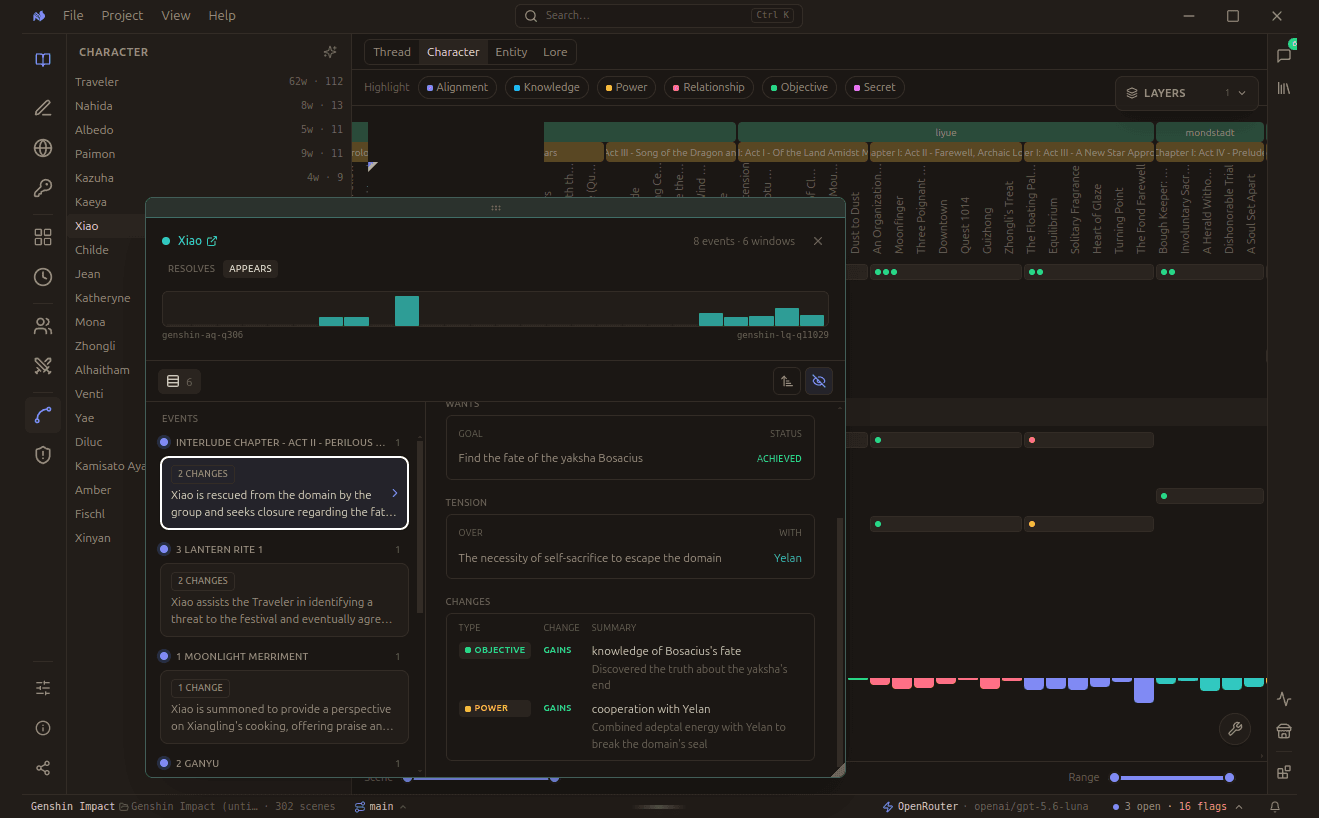
A 302-scene project. The selected character's float reports 8 events across 6 windows.
What a change is typed as
An arc is not a mood. It is a sequence of typed changes, and the type is what makes an arc queryable rather than impressionistic.
| Type | What moved |
|---|---|
| Objective | What they are trying to do |
| Knowledge | What they now know |
| Power | What they can now do |
| Relationship | Where they stand with someone |
| Alignment | Whose side they are on |
| Secret | What they are keeping, or no longer keeping |
Selecting a character opens a float with their events, and each event lists the changes it caused. The detail pane pairs a goal with its status, and a tension: what the character is torn over, and who with.
That pairing is the useful part. A goal marked achieved with no tension recorded usually means the arc resolved too easily to be interesting.
What changed - the facet
Each change is tagged with the facet it moved along (alignment, knowledge, authority, and the like) - the dimension of the character that shifted.
How it changed
| ● gains | they acquire it (a goal, an ally, leverage) |
| ● loses | they lose it |
| ● revealed | it becomes known - exposed to others or the reader |
The sheet (click a character)
A chapter railway: each chapter is a station - a stop (●) where the character changes, a hollow stop (○ ··) for a chapter they're offstage or static. Open a station to read that chapter's summary, what they want, their tension (and with whom), and the changes themselves.