
 QED
QEDInspector
What the engine understood about a scene, shown beside the scene itself.
Inspector
The Inspector is the engine's reading of one scene, in one column. It is the fastest way to check whether what you wrote landed the way you meant.
Everything in it is derived. You do not fill the Inspector in; you write a scene and the Inspector tells you what came back out. When it disagrees with your intention, that gap is the useful part.
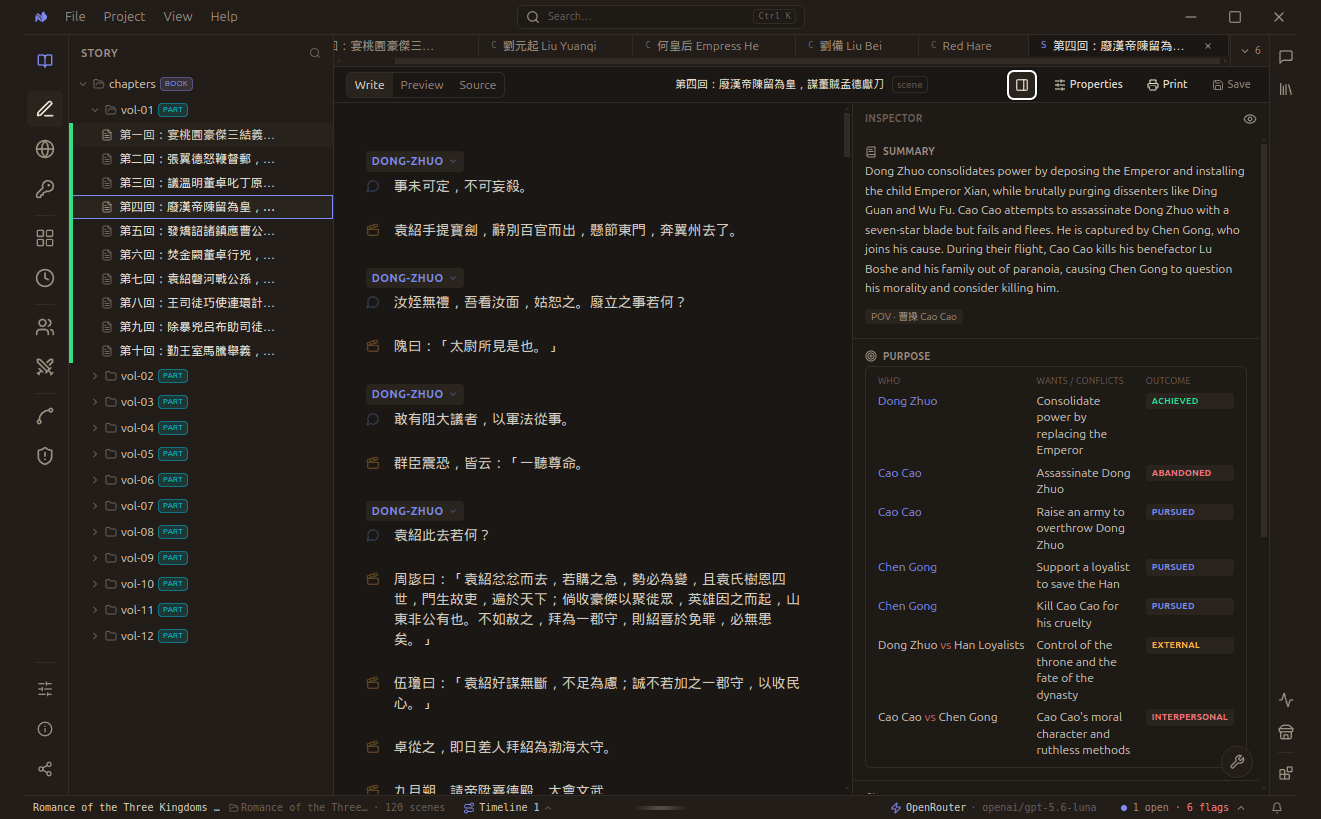
The Inspector reads the scene beside it. Every row is derived, not typed in.
How to read it
Purpose: who wants what, and how it went
The single most useful block. Purpose lists each party in the scene, what they want, and where that want ended up.
| Column | What it holds |
|---|---|
| Who | A character, or a pairing when the want is a conflict between two |
| Wants / conflicts | What they are pushing for in this scene |
| Outcome | Where it landed |
Outcomes are labelled, so a scene's shape is readable at a glance:
| Outcome | Meaning |
|---|---|
| Achieved | They got it |
| Pursued | They pushed, without resolution here |
| Abandoned | They gave it up |
| External | A conflict between a character and the world or a faction |
| Interpersonal | A conflict between two named characters |
A scene where every row reads pursued is a scene where nothing closed. That is fine mid-arc and a warning sign at a climax.
The summary above it carries a POV chip naming whose eyes the scene is told through.
What it reports
| Section | What it answers |
|---|---|
| Summary | What happens here, compressed |
| Premise | What was true entering the scene |
| Conclusion | What is true leaving it |
| Outcome | What actually changed |
| Purpose | Why this scene earns its place |
| Cast | Who is present |
| Entities | What the scene refers to |
| Threads | Which plot threads it opens, advances, or closes |
| Lore | World facts disclosed here |
| Secrets | What is revealed, and to whom |
| Custody | Anything that changes hands |
| Flags | Problems worth your attention |
Reading it well
The most valuable rows are Premise, Conclusion, and Outcome, because together they say whether the scene moved anything. A scene whose premise and conclusion are near-identical, with an empty outcome, is usually a scene that reads pleasantly and accomplishes nothing.
A blank Inspector does not mean a bad scene. It usually means the scene has not been analyzed yet, or is not set to a phase the analysis reads. Check that before rewriting anything.