What we learned reading the classics
We pointed NVS at public-domain classics to build seed datasets: Romance of the Three Kingdoms, Journey to the West, Alice in Wonderland. The engine held up. The surprise was which books made good seeds, and the one number that predicts it.
 David Len1 min read
A story engine you can only demo on your own manuscript is a story engine nobody can evaluate. So we built nvs-datasets: public-domain classics converted into NVS projects, ingested and analyzed by the same engine that reads your own work. They seed the showcase, they exercise the analysis at real scale, and anyone can open them.
The one everyone recognizes
Romance of the Three Kingdoms went in as 120 scenes. The engine tracked cast presence across the whole campaign, and the custody rail turned out to be the star: who holds the Green Dragon Sword, who rides Red Hare, chapter by chapter, hand to hand.
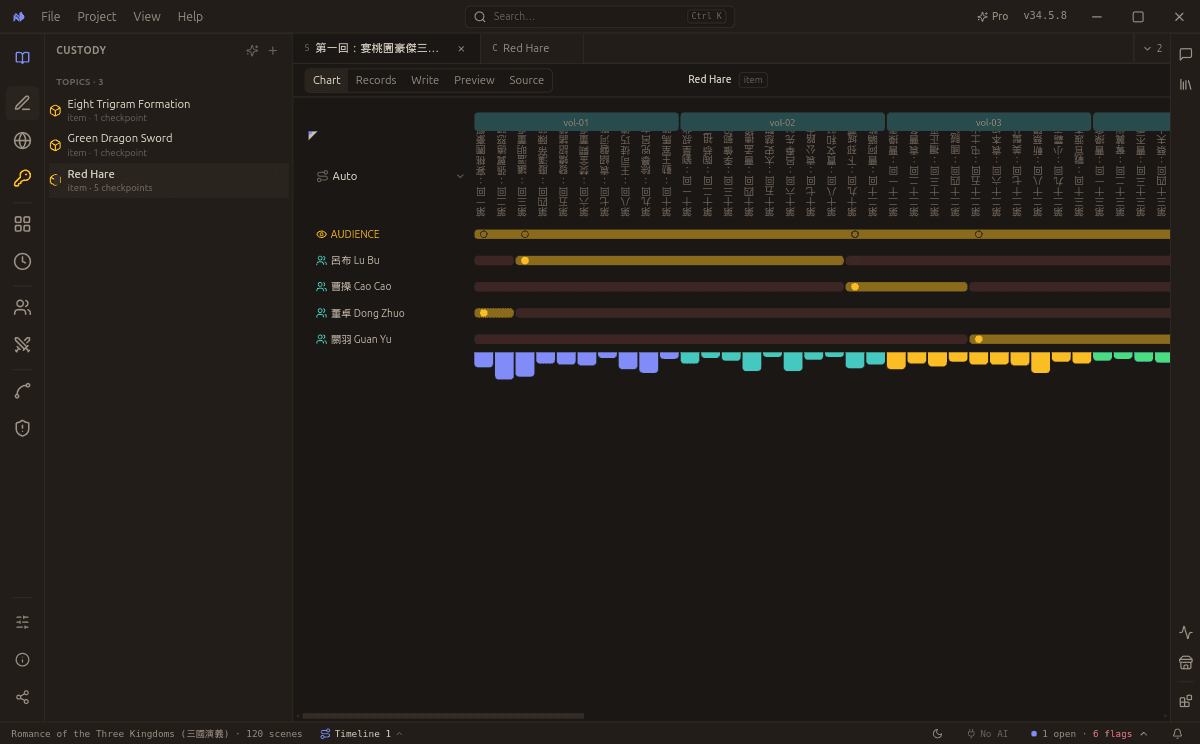
A horse changing owners sounds like trivia. It is not. Each transfer is a plot beat the text states plainly, and the rail catches every one of them, which means it also catches the one you contradict in chapter 90.
The number that predicts a good seed
Not every classic makes a good dataset. The predictor we found is dialogue density: speaking beats per scene. Alice in Wonderland runs about 25 beats per scene and produced one of the richest analyses in the library. Journey to the West runs even denser and matched it. The Call of the Wild runs about 6, and the analysis came back thin: beautiful prose, but almost nothing for a dialogue-driven engine to hold onto. We rejected it as a seed.
That tracks with what NVS is for. It is a writing IDE for dialogue-driven fiction; books that live in conversation give its ledgers the most to do.
Try them
Every listed seed ships with its analysis alongside the plain Markdown scenes. Open one in NVS, or start from the showcase.